The AI Execution Brief, edition 3
Small Businesses Don’t Need More AI Tools. They Need More Capability.
The real opportunity is not giving every business access to artificial intelligence. It is helping businesses do things they could not previously afford to do well.

Ray Ore Kufoniyi
Founder, Phoswift Inc. (Phosify) · · 4 min read
A small business owner often knows exactly what needs improving.
Customer inquiries are taking too long to answer. Quotes are prepared manually. Marketing happens only when someone has spare time. The website generates traffic but fails to turn enough visitors into customers.
The problem is rarely a lack of ideas.
The problem is capacity.
A small team cannot do everything at once. Hiring specialists costs money. Adding software introduces new subscriptions and administrative work. Even when a useful solution exists, implementing it can take time the business does not have.
This is where I see one of the most interesting opportunities for AI.
Not as another tool to learn, but as a way to expand the capabilities of a business without requiring a proportional increase in its resources.
The difference between access and adoption
It has become relatively easy to try AI. A business owner can open a chatbot, generate marketing copy, summarize a document, or experiment with an image generator within minutes.
But trying AI and integrating it into a business are two different things.
The OECD’s 2026 survey of SMEs found that adoption of AI tools is increasing, while skills gaps, time constraints, and maintenance costs continue to hinder effective implementation. The survey covered more than 2,000 SMEs across 12 OECD countries, but its sample was not representative of all SMEs, so its findings should be interpreted accordingly. Source: OECD, Empowering SMEs in the Age of AI.
The distinction matters because a collection of AI subscriptions is not necessarily a more capable business.
If employees must repeatedly move information between disconnected systems, check inconsistent outputs, and maintain complicated workarounds, the technology may add friction rather than remove it.
The opportunity lies in connecting AI to a specific business need.
Start with the work nobody has time to do
Consider a service business receiving enquiries through its website and telephone.
A prospective customer wants to understand the service, check whether the business handles a particular job, and request a quote. If the owner is busy delivering the service, that enquiry may wait.
AI could help answer routine questions, collect relevant details, and organize an enquiry for follow-up. A well-designed system might also help prepare a quote or update a customer record, subject to appropriate checks and permissions.
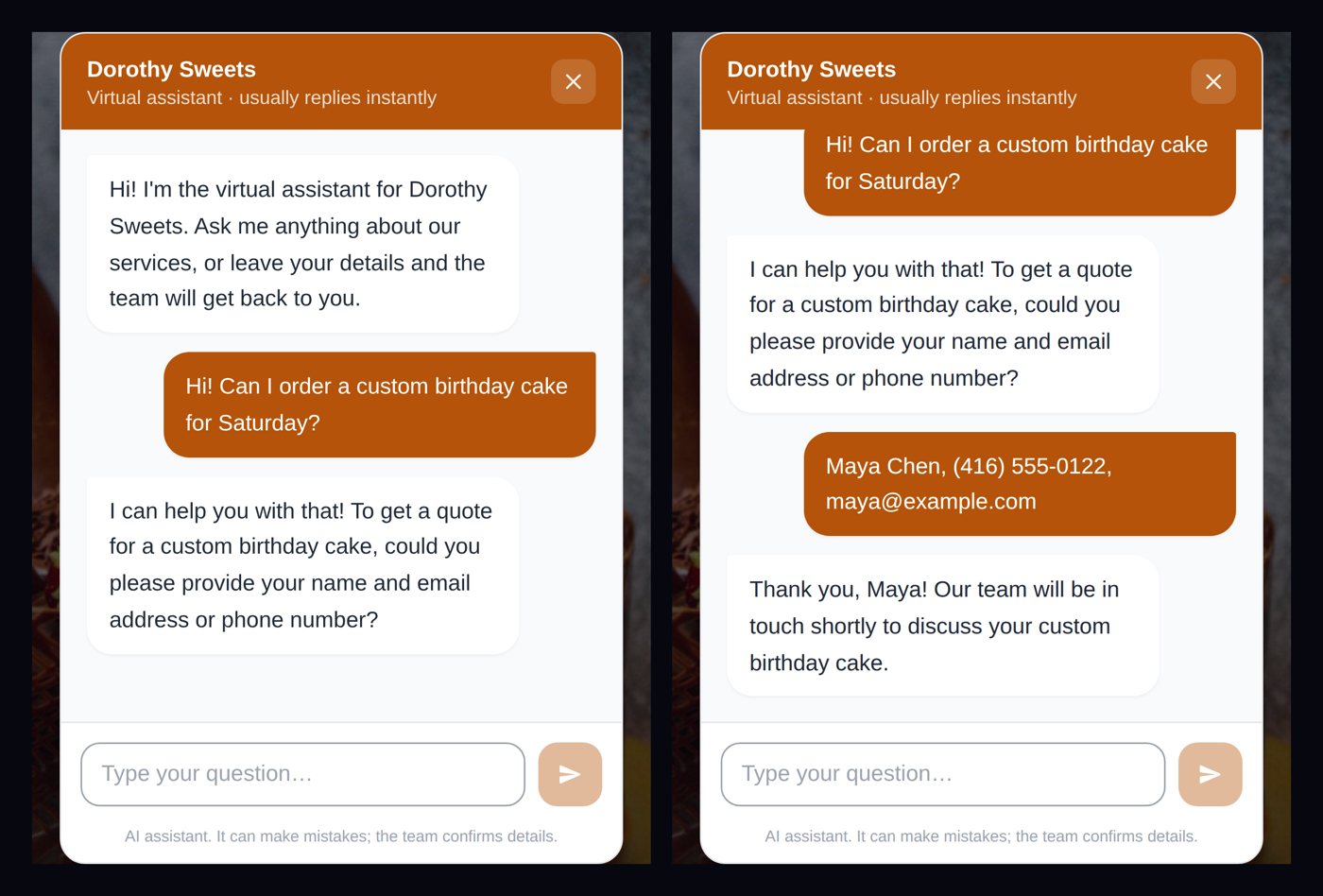
The value is not that the business has adopted an AI receptionist.
The value is that fewer opportunities are lost because the owner cannot respond immediately.
That outcome must still be measured. The system might provide incorrect information, fail to understand a complicated request, or frustrate a customer who needs human assistance. Good implementation requires clear limits and a reliable path to a person.
But the example illustrates the right way to think about AI: begin with the operational problem, then determine whether technology can solve it.
The danger of copying larger companies
Small businesses do not need to replicate the entire technology stack of a large enterprise.
They need to solve their own problems at a cost they can sustain.
A five-person business may benefit enormously from automating one repetitive workflow. Another may get greater value from improving its customer acquisition process. A third may need better inventory visibility or faster administrative reporting.
There is no universal AI stack that every company should adopt.
The right starting point is an honest assessment of where the business loses time, money, customers, or opportunities.
Then test a focused solution, measure the result, and expand only when the evidence justifies it.
A responsibility for AI founders
Those of us building AI products should take this opportunity seriously.
If a tool requires weeks of configuration, specialized technical knowledge, and constant supervision before it becomes useful, it may be inaccessible to the very businesses that could benefit from it.
Good AI products should reduce complexity rather than merely relocate it.
That means thoughtful defaults, straightforward workflows, transparent limitations, sensible pricing, and integration with the systems customers already depend on.
It also means resisting the temptation to add AI features simply because they make a product look more advanced.
Small businesses are not looking for more technology to manage. They are looking for more customers, better service, lower friction, and greater control over their operations.
AI has the potential to help them achieve those things.
The companies that deliver the greatest value will be those that understand the difference between selling access to intelligence and delivering a capability that makes a business better.